

In a first-of-its-kind study, researchers from the Consortium of Eosinophilic Gastrointestinal Disease Researchers (CEGIR) found that dupilumab improves outcomes for individuals with eosinophilic gastritis, a rare immune disease that damages the stomach.
Eosinophilic gastritis—also known as EoG—occurs when white blood cells called eosinophils build up in the digestive tract in association with injury and inflammation. For individuals with EoG, this makes eating difficult or even impossible. Heartburn, nausea, vomiting, weight loss, and bloating can be painful and lifelong.
“Currently, there are no FDA-approved medications for EoG,” says co-first author Nirmala Gonsalves, MD, of CEGIR and Northwestern University. “This is a huge unmet need for patients, as guidance on treatment is limited to small case series and expert opinion.”
In 2022, the FDA approved dupilumab—an antibody that treats inflammation—for use in patients with eosinophilic esophagitis (EoE). As EoE and EoG are both types of related eosinophilic gastrointestinal disorders (EGIDs), researchers wanted to find out if patients with EoG could also benefit from treatment with dupilumab.
To begin a clinical trial, researchers first had to identify outcome measures to help them evaluate dupilumab’s effectiveness in EoG. This is part of the process of developing “clinical trial readiness,” one of the main goals of the Rare Diseases Clinical Research Network (RDCRN). The team used findings from the CEGIR-funded Outcome Measures in Eosinophilic Gastrointestinal Disorders Across the Ages (OMEGA) study to define how they would assess the results.
“This trial would not have been possible without the collaborative and logistic framework provided by CEGIR,” says co-first author Evan S. Dellon, MD, MPH, of CEGIR and the University of North Carolina at Chapel Hill. “In order to study a rare disease, multiple experts have to come together with a common purpose, and the investigators in CEGIR are committed to pushing the EGID field forward with groundbreaking trials.”
The team worked with patient advocacy groups to recruit 74 patients; ultimately, 41 with EoG were qualified for the study. Participants were given dupilumab or a placebo for 12 weeks. Then, researchers evaluated outcomes, including eosinophil counts in the stomach.
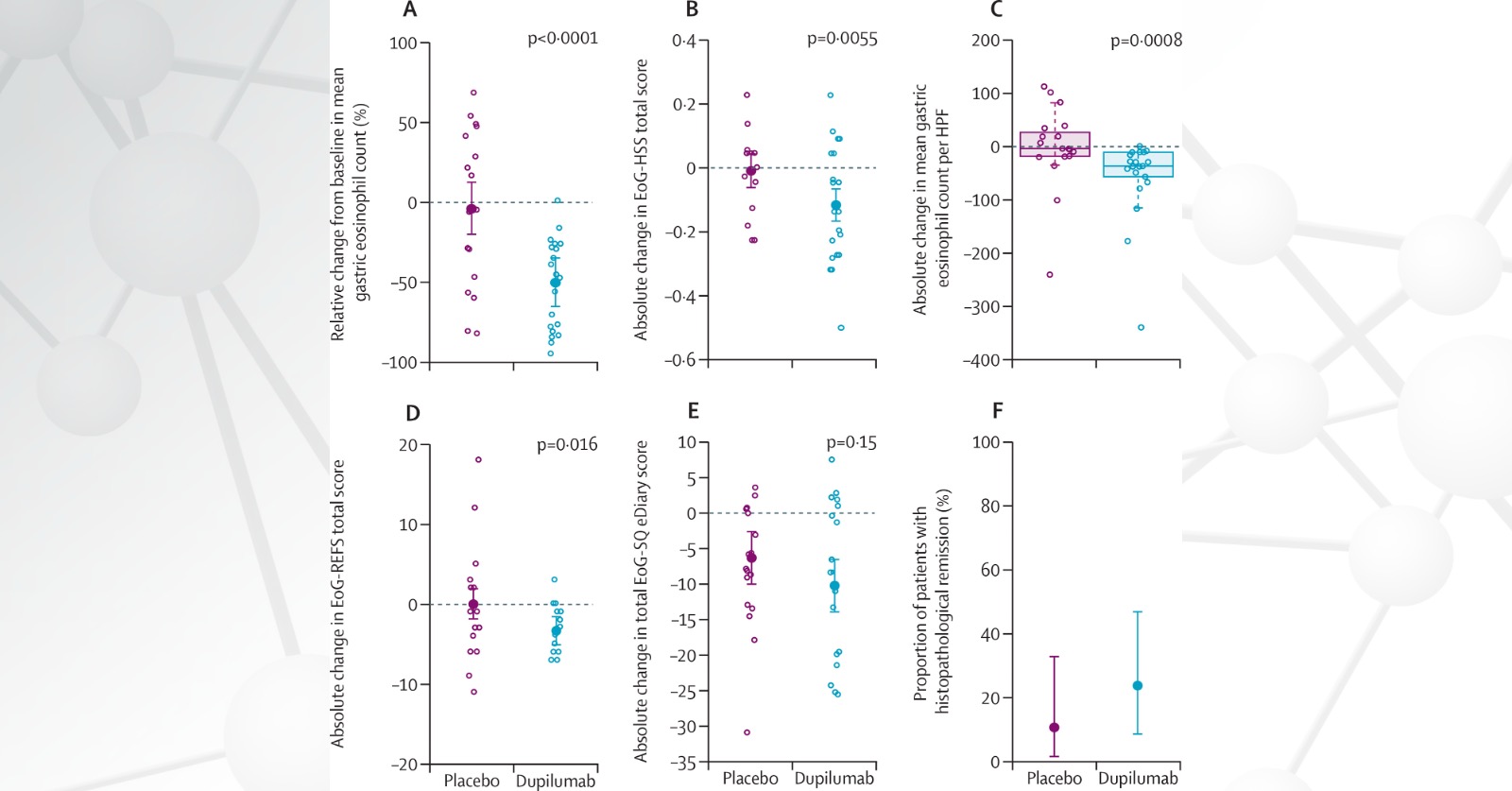
Results showed that dupilumab improved the primary outcome and several secondary outcomes, including gastric eosinophil counts, histopathologic and endoscopic abnormalities, and transcriptomic biomarkers compared to the placebo group. The findings suggest that EoG is driven by an overactive immune response called type 2 inflammation.
“The results were extraordinary,” says lead author Marc Rothenberg, MD, PhD, principal investigator of CEGIR. “We learned a great deal about the disease, even during the recruitment phase as we compared the eligible and non-eligible patients, which helped us determine the disease features and how to properly make a diagnosis, an ongoing goal of the OMEGA study. The results yielded dramatic effects, reaching the primary endpoint and many of the secondary endpoints. Also, the exploratory molecular-based studies provided deep information about the disease’s pathogenesis and target engagement by the drug.”
Now that dupilumab has shown value in treating EoG, there is justification for using dupilumab off label. The researchers also plan to conduct a larger study, potentially leading to FDA approval.
“These findings provide a framework for larger-scale studies in this area and provide understanding into the mechanisms of inflammation in these disorders,” says Dr. Gonsalves. “Information gained from research like this brings us one step closer to providing much-needed treatment for our patients.”
Read the full study in The Lancet Gastroenterology & Hepatology.


